
Our Armoury and tools of war ...
We have a very varied armoury and it is our pleasure to share with you some of the wonderful hand crafted weapons from the era. The military display team train to replicate the techniques of the time and we pride ourselves on not only providing a great live show, but also an educational tour for those that are interested. Here are a few of our weapons, should you wish to purchase any hand crafted item, then contact us directly for prices dependent on requirements. We work in partnership with craftsmen from around the world.
Our blades are mostly blunted and combat ready. They weigh approximately the same as their historic originals, but of course use modern means for production and safety reasons. We do not represent HMA combat, but like to think we are skilled in the weapons of the time. We can arrange informative sessions either for interest and fun, language studies, educational sessions, or team building activities.
They are reproductions which weigh approximately the same as their originals. As before, each bore the quality of the maker, whereas some are mass reproductions, most our weapons come from independent blacksmiths, who are dedicated to the authenticity of their work. They serve pretty well to hit each other with as well (all within the realms of strict safety!).
 IMG_1953_edited | ![[2015 10] The Armoury 41](https://static.wixstatic.com/media/406e0d_9fd52696352a4b77af8b71135b5593d0.jpg/v1/fill/w_250,h_187,al_c,q_90,enc_auto/406e0d_9fd52696352a4b77af8b71135b5593d0.jpg) [2015 10] The Armoury 41 |  Wepons arrayWe try to study techniques of combat from the time, based on the known fight masters and their works. In particular from |
|---|---|---|
![[2015 10] The Armoury 68](https://static.wixstatic.com/media/406e0d_e1274ae8fa4a41afaadbfdcbf0c5f089.jpg/v1/fill/w_250,h_201,al_c,q_90,enc_auto/406e0d_e1274ae8fa4a41afaadbfdcbf0c5f089.jpg) [2015 10] The Armoury 68 |  BreastplateThe cuirasse reborn when wrought iron and later steel became the norm for the men at arms. It's usage continued into the musket era and beyond. Dependent on quality, and desired weight, it would be around 1-2mm in thickness. |  HauberkThe chain mail hauberk was a staple for many centuries. It would have been used to protect the holes in the plate armour that many men at arms would piece together. |
 The Pointy BitTo quickly equip an army, then cheap pike or spear tips could be produced t defend the land. Here we have the spear tips used with the pavise. A weapon from antiquity, it would not stop a Knights charge, and thus the pike replaced it as a staple for the levied masses. |  The sign of God?What is the question? Was the sword built as a replica of the cross, as many contemporary writers would have us believe or was it just a further protection of the hands to stop the opponents blade sliding down the edge. Certainly a sword hilt represents the cross, ad would have been strongly used in latter day imagery, but didn't the men at arms hold it in the opposite way? |  FrancescaThe axe was not just used for chopping. In an earlier period, the theory goes that they used very much as a frag grenade. Thrown at a formed shield wall, then followed by a ferocious charge...what better way to start a battle. |
 EscutcheonThe field is quartered, or party per cross. This type was more probably used to declare kinship or ties. Embolden old claims. Heraldry is a rich part of our display. |  The LionRed Lion Rampant, commonly used by the Habsburgs c. 1340. Each symbol and it's position had a reason and was meticulously recorded for validity. Very much like pedigree certificates for prize animals of today. |  Castle or Keep quarteredThe order of the symbols, and their duplication across quadrants was common place. Each quadrant having an importance linked to the male heritage and it's dynasty line. |
 GauntletsPerhaps the most underestimated arm of the time? Many images are conjured of brave swash buckling Men at arms, clashing blades. For one to 'clash' blades you risk to damage it's edge, and also you are not on the winning end of the duel. Therefore a good old shield, or simple fist punch would have also been as effective as one could imagine. Combat must have been brutal and physical. A plated fist would have made it's mark. |  The GorgetNo part of the body was left unprotected, but yet armour had to be adaptable to the conflict. Many foot soldiers would flat rimmed hats to protect from arrows descending on them. The bevor would have fit with sallet, kettle hat, or even a spagen helm. |  The Shiny plateOne thinks of the gleaming aluminium of King Arthur, or the dirt and grime of Highlander. The times were not as grimy as Hollywood wants us to imagine. Finishing would have taken time, and for sure would not have been solely for decoration. Men at arms would look after their tools, and certain techniques are still used in today's households. |
 CrossbowEasier to fire than the longbow, the crossbow was used by many across the age. Although a lower rate of fire it could puncture mail and sometimes plate. |  Chain MailA fully armoured knight would have used mail to cover their exposed joints. More often than not a hauberk and skirt with coif. At least adding a good 10kg more to the mix. |  The Heater shieldMade of wood, hardened leather, it not only provided protection, but was a weapon itself. Our shields are hand made and battle ready. |
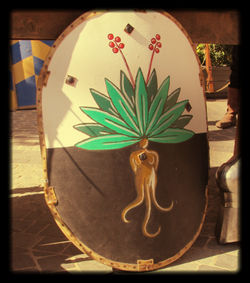 HeraldryEach part of the design was meant to signify a passage of arms, a birth right. Throughout the age of chivalry, war has been made upon symbols such as a simple rose. |  Quarrel or BoltsThe french derived quarrel or or 'studded bolt' was easier to produce than a larger arrow. The crossbow and pavise was a common site around the Mediterranean basin. |  Sallet with helmet tailThe forefather of modern day firefighting helms, the sallet offered all round protection. Usually attached to a gorget and bevor, to protect under the visor. |
 The one handed swordEach of our swords are reproduced based on historical designs. The weight and balance are just as important as the design, and a sword fits a swordsman's hand and grip. |  Mounted ChevalierTrue to say that the era is renowned for the image of the Knight on horseback. Many mercenaries had access to a horse. The battle of pike and horse had begun. |  The AxeWeapon which dates back in the ages. Although it was not the glorified tool of film. The peasants would have taken what was available and the axe still would perform as well on wood as bone. |
 Pavise UnitThe pavise shield was synonymous with crossbow units. The Bohemians used these with a spear for an effective defense unit. |  Show piecesAll our members take pride in their equipment. Most are hand made replicas, and some are tailor made specifically for their owners. |  Protection was keyAs weaponary improved, so did the protection. The knight was as good as as his plate. Our displays offers a wide range of armour for all to try. |
 The Halberd or Pole AxeAs armour improved so did the weapons. To keep a plated man at arms at bay, the foot soldiers would use this weapon and it's three attacked prong. The point, the blade and the hook. |  Plate armourA fully suited plated man at arms was formidable. Although not invunerable, certainly could withstand blows in the midst of a confusing and bloody battle. |  The PikeOver 3m of wood with a point. The pike wasn't noble, but it was easily handled, units could be trained quickly and it was a cost effective way of raising the levvy. Towards the end of the period, the lowly pike would add to the demise of the Knights. |
 Langemesser or falchionHere the long knife shows a guard which must have represented a large part of medieval hand to hand combat. The knuckle protection would have been used for close in fist fighting. |  The Flanged maceDeadly on horseback, easier to use on heavy plate where blunt force trauma was needed. The flanges provided the extra penetration needed. |  The DaggerThe popular knife or seax was replaced by the knightly dagger. Often known as a sword hilt dagger, due to the shape of the hilt. Being duel edged shows it being a true pierce and thrust weapon. |
 Anakron's archersSimple and composite bows are on show, and the skills needed to fire them. |  Weapons displayOur armoury set up displays a wide range of weapons used in the period. All of the weapons are safe for Historical re-enactment and blunted for combat. |  Flanged macesNot only a deadly weapon on horse, but equally on foot. The mace was also supposed to be a symbol of authority, which continues to this day in many official ceremonies. |
 LangemesserThe 'long knife' from the late medieval period and based on the infantry mans single bladed cutting weapon, the falchion. |